Pensions · Deferred membersWrite-up on Substack
Enabling deferred members to restart pension contributions online

When I left my employer, who opened a pension pot for me with Aviva, I was left with two choices: combine it with my new pension scheme or leave it.
I chose the latter, but here is the problem: I have to pay it manually; setting up a recurring payment in the Aviva app is impossible. I hate calling customer support, and to be honest, I'd rather not walk to the post office to mail a direct debit mandate. So where do we go from here?
Read the full write-up →Let a member who has left their employer initiate recurring Direct Debit payments into their existing Aviva pension pot by extending the existing single payment flow Aviva has already created, rather than having it currently fall back to a paper mandate once money needs to be moved on an ongoing basis.
If a member logs in to the 'deferred' pot and goes to the pension to top it up, their only option in MyAviva is 'Make payments into your pension', which only facilitates one-off payments. There's nowhere in the app to set up regular or recurring contributions. The one-off payment takes you to a three-step form.
It asks about member status (the relief-at-source question), then employment status, amount with the tax relief being grossed up in real-time, source of the funds, followed by electronic identity and AML checks by an external provider, investment allocation (defaults to your existing allocation), and finally a comprehensive declarations page with a tick box confirmation.
After you click accept on that final step, the money still doesn't change hands. Instead, you're presented with a message that says: “send us a BACS or bank transfer for £XX to [Account number], reference number: [Plan number]. We can't action your payment until we receive it”. Credit cards are not accepted either.
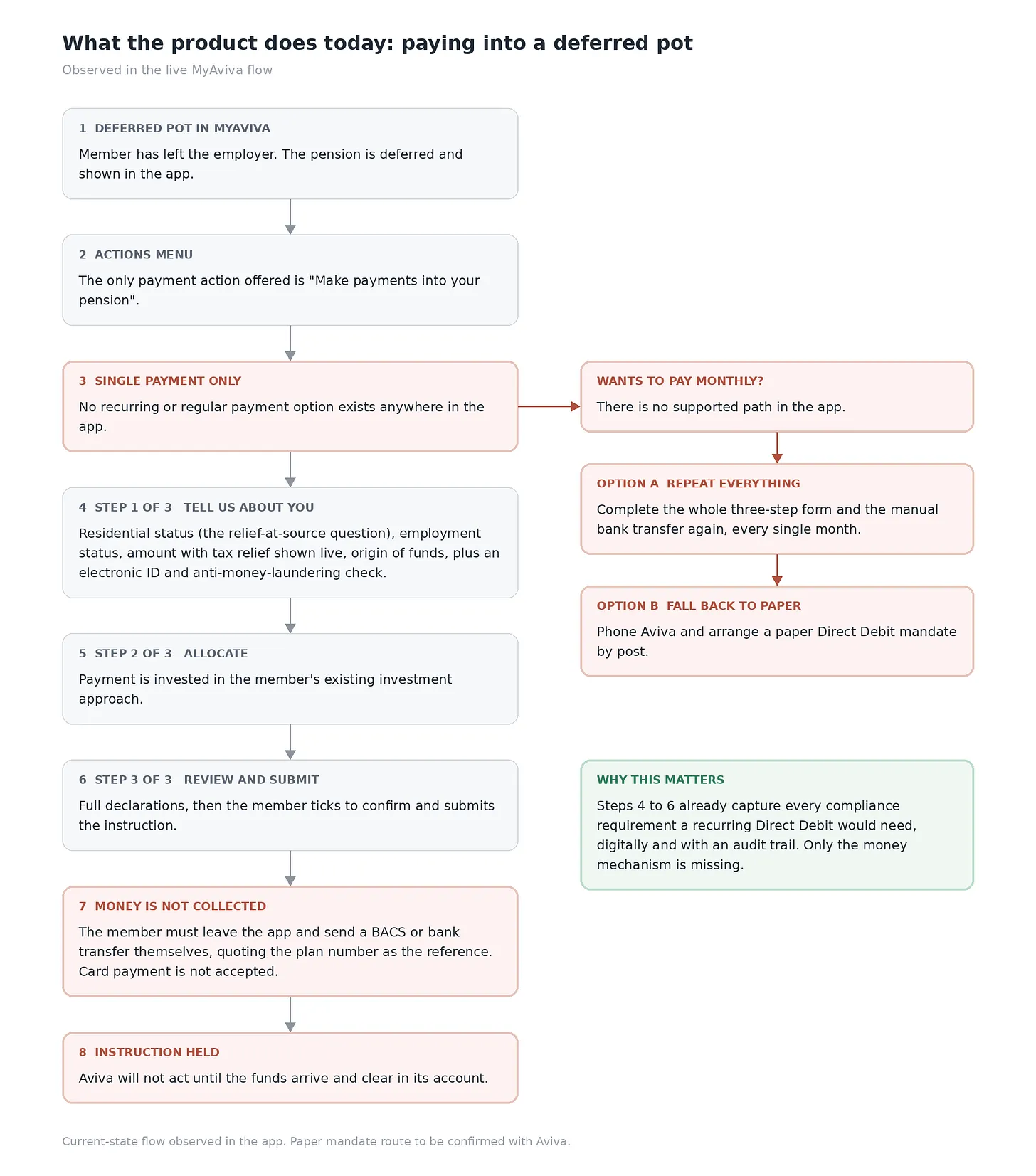
Aviva already has the hard work of the process built for single payments. All of the compliance points required to enable a Direct Debit can be found and captured in the existing flow: the relief-at-source questions, source of funds and AML checks, ID verification, investment allocation, declarations — all exist, and they work.
The only part missing is the money transfer element: the ability to store the member's bank details, create an AUDDIS Bacs Direct Debit Instruction, and optionally set the payment frequency. The compliance requirements for a paper mandate are already satisfied digitally, so the request becomes extending what's already there, not rebuilding compliance.
A member with a deferred pot who wants to start contributing from their own money. These are motivated, liquid members that would be easy to retain and quick to lose through friction.
Daniel, 35, member with a deferred pot. He recently left the employer that sponsored his Aviva workplace pension, now manages the pot via the app, and is digitally savvy. Since changing jobs, he wants to continue contributing to his pension pot. He cannot initiate recurring payments from the app, so having to make manual payments each month means his initial intention to continue saving lapses over time.
As someone with a deferred Aviva pension from a previous employer, I want to set up a recurring Direct Debit from within the app, so that I can consistently save for my retirement without the hassle of monthly manual payments.
Quick win. Integrate a Direct Debit at the end of the current single-payment flow, asking the member if they want to set this up as a regular payment. This leverages existing screens and turns a one-off process into an optional recurring one, also making the one-off payment an actual pull instead of a push.
The full path. Introduce a “set up a regular payment” option in the pension's actions menu. This path would go through the existing declaration and checks, collect bank details once, and register an AUDDIS paperless Direct Debit with amount and frequency options that the member can change.
What I would actively not do. Avoid asking the member to email back a signed mandate. An email containing a signed Direct Debit mandate includes personal banking details, creating security risks, and would be rejected by Aviva's security. The aim is to avoid the mandate leaving the product altogether.
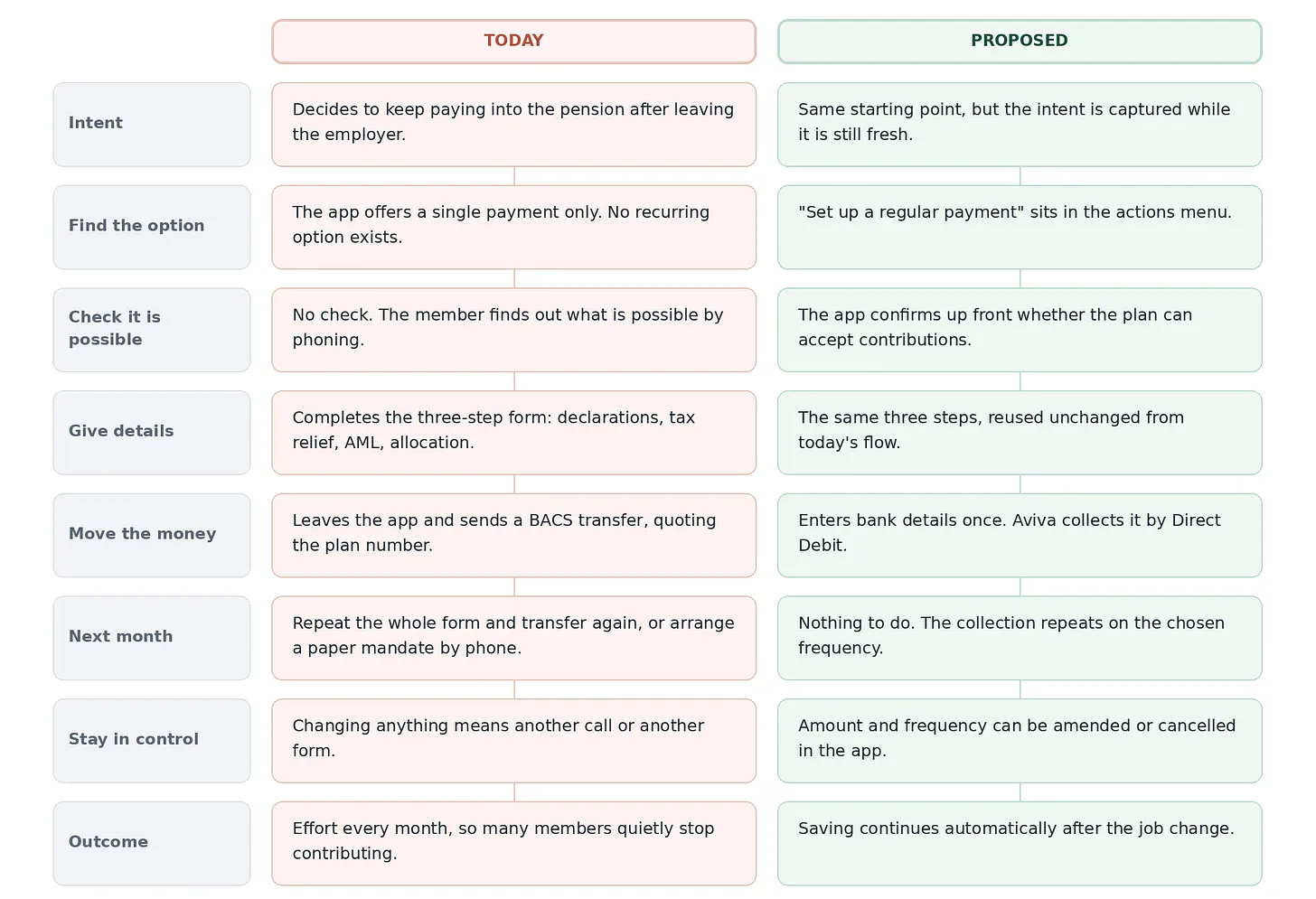
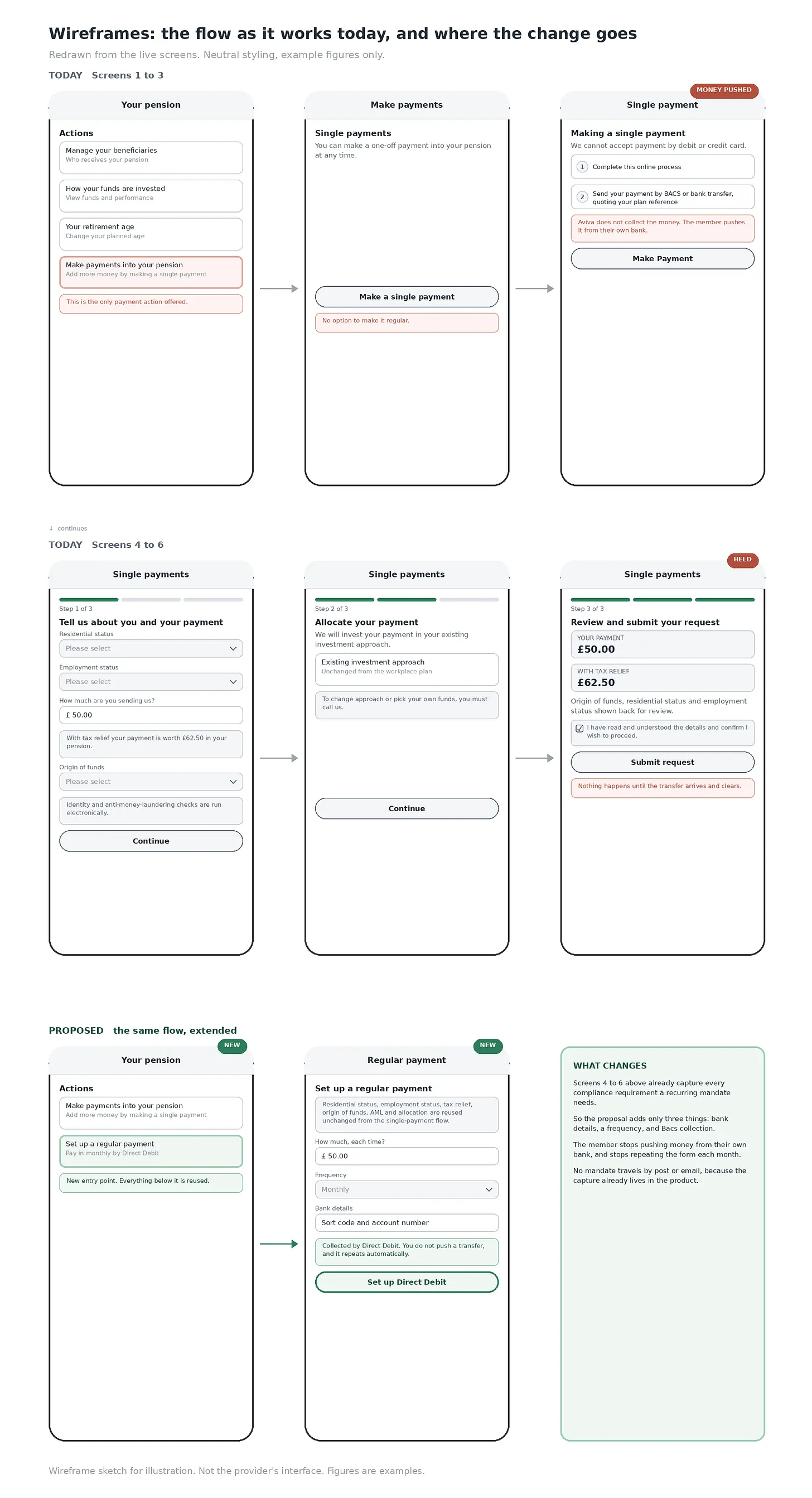
The key is that we're not aiming to just speed up an existing manual process, but rather removing a manual step and a missing functionality entirely by building upon what Aviva already has in place.
Positioned on a 2x2 matrix of impact versus effort, the Direct Debit collection falls into the quick win section because much of the flow already exists. The eligibility check would be the foundational element.
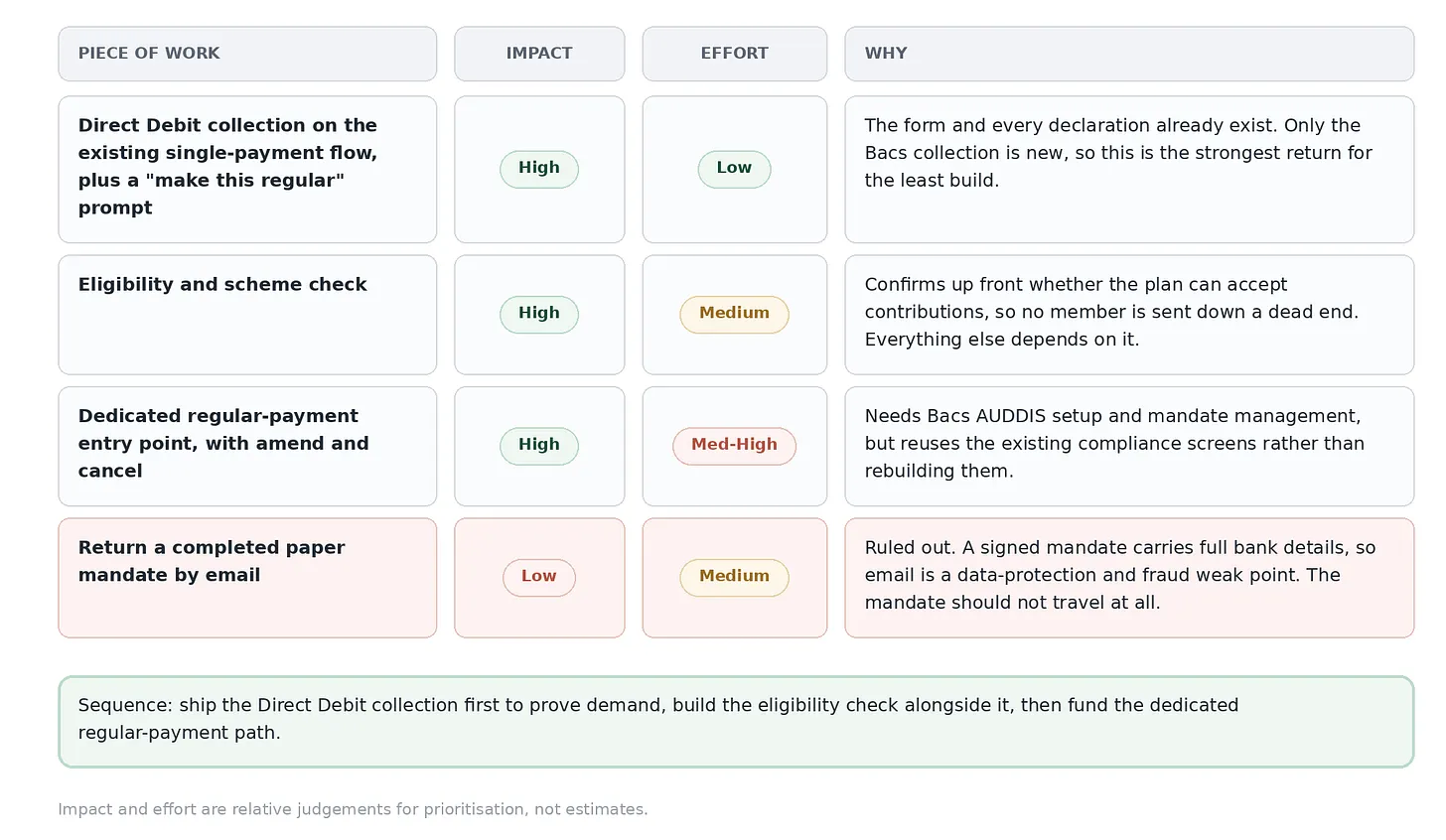
The dedicated recurring flow represents the larger project, but will be much smaller than it appears thanks to the reusable compliance UI. Recommended phased approach: quick win including the eligibility check, then a full recurring payments flow.
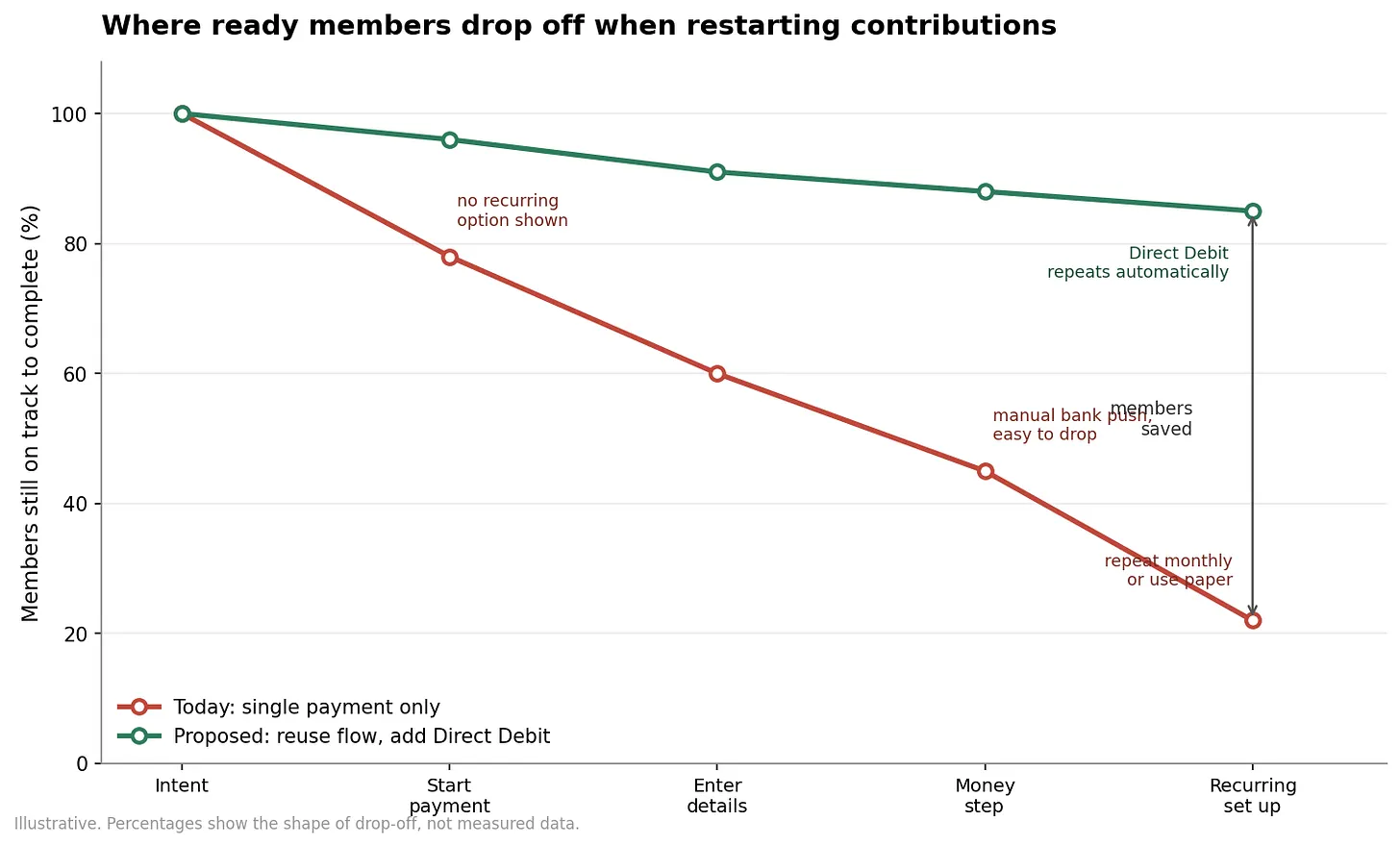
Time taken from member intent to payment collection, in days.
The ratio of contributions initiated to actually completed.
The percentage of single-payment users who convert to a recurring Direct Debit.
The amount of recurring contributions recovered from deferred members quarterly.
The member has already decided to save. Every step of manual friction is a chance for that decision to unravel.
Because the compliance flow already exists, this is a rare case where a small, contained build protects retirement outcomes for the customer and recurring revenue for the business at the same time.